User
Defined Function
Why we need functions in C?
Functions are used because of
following reasons –
·
To improve the readability of code.
Improves the reusability
of the code, same function can be used in any program rather than writing the same
code from scratch.
·
Debugging of the code would be easier if you use functions,
as errors are easy to be traced.
·
Reduces the size of the code, duplicate set of statements are
replaced by function calls.
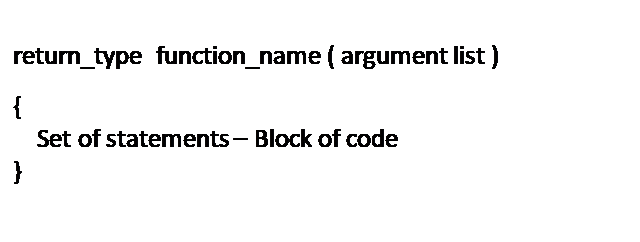 Explain Syntax and Terminology used
in a function.
Explain Syntax and Terminology used
in a function.
·
return_type:
Return type can be of any
data type such as int, double, char, void, short etc.
·
function_name:
It can be anything,
however it should be a meaningful name for the functions so that it would be
easy to understand the purpose of function just by seeing it’s name.
·
argument list:
Argument list contains
variables names along with their data types. These arguments are kind of inputs
for the function.
·
Block of code:
Set of C statements, which
will be executed whenever a call will be made to the function.
How to call a function in C?


Example-1: WAP to display
WELCOME using function.
#include<stdio.h>
void Display()
{
printf(“welcome”);
}
void main()
{
Display();
}
Example-2: WAP to Add two
number using Function.
#include<stdio.h>
void Add()
{
int A,B;
scanf(“%d %d”, &A,&B);
prinf(“%d” A+B);
}
void main()
{
Add();
}
Type of User-Defined Function
Case 1: No Way Communication (No
arguments passed and no return value)
Example-1
#include<stdio.h>
#include<conio.h>
void ADD()
{ int A,B,C;
scanf(“%d %d”, &A, &B);
C
= A + B;
printf(“%d”, C);
}
void main()
{
Add();
}
Case 2: One Way Communication (arguments passed
and no return value)
Example-2
#include<stdio.h>
#include<conio.h>
void ADD(int
A, int B)
{ int C;
C
= A + B;
printf(“%d”, C);
}
void main()
{ int X,Y;
scanf(“%d %d”, &X, &Y);
Add(X,Y);
}
Case 3: One Way Communication (No arguments passed and return value)
Example-4
#include<stdio.h>
#include<conio.h>
int ADD(int
A, int B)
{ int A,B,C;
C
= A + B;
return C;
}
void main()
{ int Z;
Z = Add();
printf(“%d” , Z);
}
Case 4: Two Way Communication (arguments passed and return value)
Example-4
#include<stdio.h>
#include<conio.h>
int ADD(int
A, int B)
{ int C;
C
= A + B;
return C;
}
void main()
{ int X,Y,Z;
scanf(“%d %d”, &X, &Y);
Z = Add(X,Y);
printf(“%d”, Z);
}