MESSAGE
AUTHENTICATION
Previously, we have seen
and understood on the data
integrity threats,
·
and the
use of hashing technique to detect if any modification attacks have taken place
on the data.
Another type of threat
that exist for data is the lack of message authentication.
·
In this threat, the user is not sure about the originator of
the message.
Message authentication can be provided using the cryptographic techniques
that use secret keys as done in case of encryption.
Message
Authentication Code (MAC)
· MAC algorithm is a symmetric key cryptographic technique to provide message
authentication. For establishing MAC process, the sender and receiver share
a symmetric key K.
· Essentially, a MAC is an
encrypted checksum generated on the underlying message that is sent along with
a message to ensure message authentication.
The process of using MAC
for authentication is depicted in the following illustration –
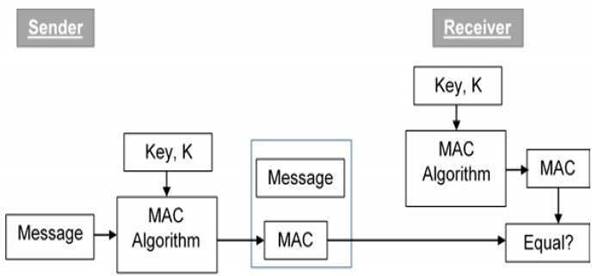
Let us now try to
understand the entire process in detail −
·
The sender uses some publicly known MAC
algorithm, inputs the message and the secret key K and produces a MAC value.
·
Similar to hash, MAC function also compresses an arbitrary
long input into a fixed length output. The major difference between hash and
MAC is that MAC uses secret key during the compression.
·
The sender forwards the message along with the MAC. Here, let
assume that the message is sent in the clear, as there are concerned of
providing message origin authentication, not confidentiality. If confidentiality
is required then the message needs encryption.
·
On receipt of the message and the MAC, the receiver feeds the
received message and the shared secret key K into the MAC algorithm and
re-computes the MAC value.
·
The receiver now checks equality of freshly computed MAC with the
MAC received from the sender. If they match, then the receiver accepts the
message and assures himself that the message has been sent by the intended
sender.
·
If the computed MAC does not match the MAC sent by the sender, the
receiver cannot determine whether it is the message that has been altered or it is the origin that has been falsified. As a bottom-line,
a receiver safely assumes that the message is not the genuine.
Limitations
of MAC
There are two major limitations
of MAC, both due to its symmetric nature of operation −
·
Establishment of Shared Secret.
o It can provide message
authentication among pre-decided legitimate users who have shared key.
o This requires
establishment of shared secret prior to use of MAC.
·
Inability to Provide Non-Repudiation
o Non-repudiation is the
assurance that a message originator cannot deny any previously sent messages
and commitments or actions.
o MAC technique does not
provide a non-repudiation service. If the sender and receiver get involved in a
dispute over message origination, MACs cannot provide a proof that a message
was indeed sent by the sender.
o Though no third party
can compute the MAC, still sender could deny having sent the message and claim
that the receiver forged it, as it is impossible to determine which of the two
parties computed the MAC.
Both these limitations can be overcome by using the
public key based digital signatures discussed in following section.