DISTRIBUTED STATE MACHINE REPLICATION
Step-1
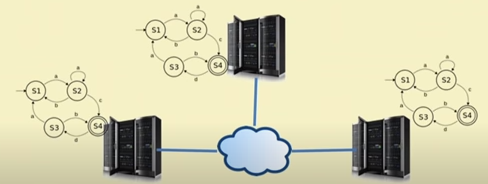
Place copies of the state
machine on multiple independent servers.
·
now in a typical distributed architecture, the distributed state
machine replication mechanism works in this way
·
so you
have multiple servers which work in a distributed fashion so the advantage of
using distributed servers in place of a centralized server that we discussed
earlier
·
so the
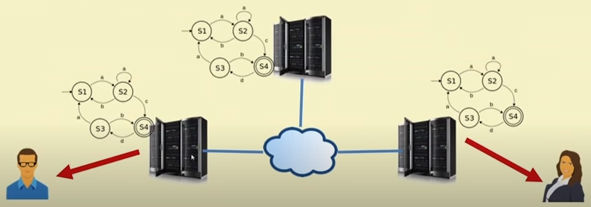
idea is that first, you have multiple servers here
·
so you
place the copies of the state machine on each of the servers so each of the
servers has a copy of this interstate machine.
Step-2:
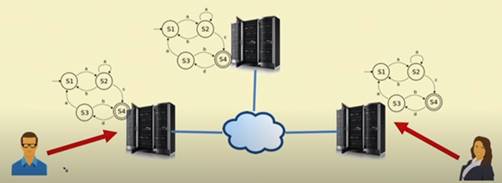
Receive client requests, as an input to the state machine.
·
then servers get that client request so here it is like that Bob
is submitting his request and Alice submitting her request
·
then the request goes to different servers
·
now when the requests are going to the different servers so if
you execute the state independently at its server the state that will be there
in left server and the state that will be there in the right server
·
they may be different so here you will reach to a state that Bob
has transferred the money
·
here you have reached the state that Alice has transferred the
money but collectively you have to ensure that all the three server reaches to
a state
·
after a certain time that both Bob and Alice have transferred
their share of the money so to achieve this the state machine replication
mechanism works in this principle
Step-3:
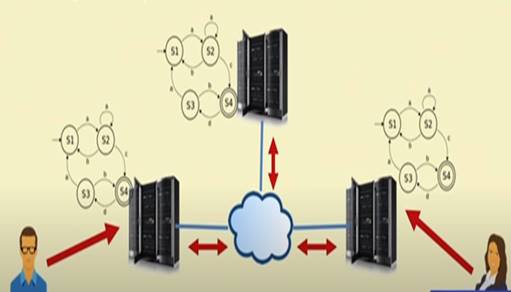
Propagate
the inputs to all the servers.
·
you propagate these inputs to all the servers so all the servers
as the input like that Bob has transferred the money and Alice has transferred
the money
Step-4:
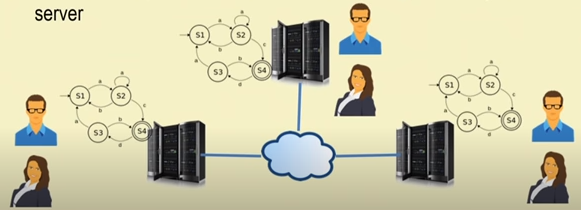
Order
the input based on some ordering algorithm.
·
then you order the inputs based on a certain ordering algorithm
·
you can have an associated timestamp with every individual
transaction whenever bob is making his transaction it is associated with a
timestamp and
·
when Alice is transferring her share of the money that
particular transaction is associated with another timestamp
·
so
based on that timestamp you can have an ordering of the transactions and then
once this order is done
·
then every individual system they execute the inputs based on
the orders which have been decided and they execute it individually at each
server
·
now once this information is executed in each server in that particular ordering algorithm then you know that well first
the transaction corresponds to Bob that will get executed in the transition
corresponds to Alice that will get executed and
·
all the server’s reaching to the same state that both Bob and
Alice have transferred their share of the money
Step-5:
Sync
the state machines across the servers, to avoid any failure.

·
so once
these transactions are done
·
then sync the state machines across all the servers to avoid any
failure
·
it may happen that the left server during the execution it has
failed and after some time it recovers
·
so once
it recovers it should get this updated state that will both Bob and Alice has
transferred their share of the money
·
so that update is done through synchronization of the state
machine nowhere in this entire algorithm
Step-6:
if
output state is produced, inform the clients about the output.
·
we have certain outputs that can be produced like it may happen
that well the output is when both the share of the money has been transferred
you send the output or you notified that client that well the job is now ready
to get executed so that particular output is sent from the server to the
individual users now in this entire procedure there are two glitches the first
one is that you need to maintain an ordering service and the second is that in
the presence of failure you need to ensure that all the individual servers are
in the same page everyone knows that well Bob bought both the transactions from
Bob and Alice they got executed and the inter money has been transferred