How Permissioned and
Permissionless Blockchains Are Similar
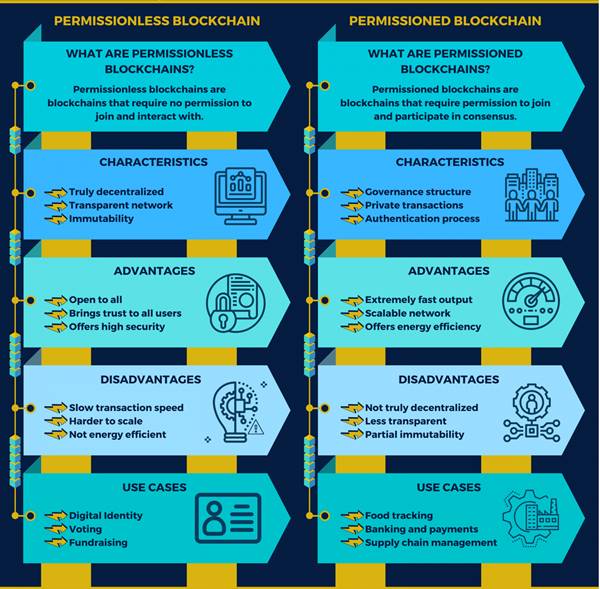
With a clear understanding of
definition, advantages, disadvantages, and use-cases of both permissioned and permissionless
blockchains, it is now necessary to learn similarities between them.
·
Both of the
blockchain types fall under the distributed ledger
definition. This means that both of them are
distributed ledgers and can be used to store and transact data securely within
its limitations.
·
As both of them
are DLT (Distributed Ledger Technology), they use consensus mechanisms to
validate transactions. The choice, however, depends on the blockchain and what
they are trying to achieve.
·
Lastly, both of DLT’s store data
in an immutable state. This means you can’t alter or
update the data once you add it in the ledger, giving the network reliability.
Permissioned vs Permissionless
Blockchain