Paxos Algorithum
As one of the main
algorithms in distributed consensus, Paxos requires at least two phases to reach an agreement:
·
the preparation phase (the request to prepare) and
·
the acceptance phase (the request to accept).
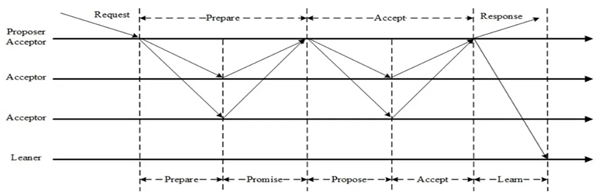
The preparation
phase implements the following purposes:
- Win over the proposal right: Only when the right to propose
is obtained can a proposal be initiated in the acceptance phase.
Otherwise, the right to propose needs to be obtained again.
- Learn
the values that have been proposed.
The acceptance stage
collects proposals into a majority. Once the majority of proposals is
determined, the resolution is reached and can be learned. If the acceptance
phase is rejected, the preparation phase needs to be gone through again.
Multi-Paxos
The basic Paxos
algorithm requires at least two network trips to reach a resolution. In the
case of concurrency, the algorithm might need more. In extreme cases, it might
even produce a livelock, which is inefficient. To address this issue, Multi-Paxos was proposed.
Livelock occurs when two or more processes
continually repeat the same interaction in response to changes in the other
processes without doing any useful work. These processes are not in the waiting
state, and they are running concurrently. This is different from a deadlock
because in a deadlock all processes are in the waiting state.
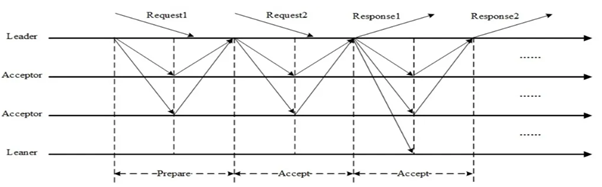
Multi-Paxos elects a leader, and the proposal is initiated by the
leader. Due to zero competitions, the livelock problem is eliminated. If all
proposals are initiated by the leader, the preparation phase can be skipped to
change the two-phase process to a one-phase process, which improves the
efficiency.
Multi-Paxos does not
assume a unique leader. Instead, it allows multiple leaders to propose requests
concurrently without affecting safety. In extreme cases, it degrades to Basic
Paxos.
The difference between multi-Paxos and Basic Paxos does not lie in
multiplicity, because Basic Paxos also supports multiplicity. The point is that
Multi-Paxos can be optimized to skip the preparation phase and directly enter
the acceptance phase when the same proposer makes continuous proposals.
Raft Algorithm
Unlike Paxos, which is
derived directly from the distributed consensus problem, Raft is proposed from
the multi-replicated state machine. It uses stronger assumptions to reduce the
states to be considered, making it easy to understand and implement.
Raft and Multi-Paxos
are highly related. The following sections summarize the similarities and
differences between Raft and Multi-Paxos.
Raft
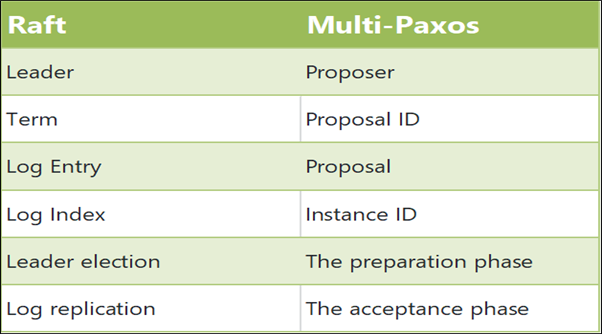
and Multi-Paxos have the following similar concepts:
- The
leader of Raft is the proposer of Multi-Paxos.
- The
term of Raft is essentially the proposal ID of Multi-Paxos.
- The
log entry of Raft is the proposal of Multi-Paxos.
- The
log index of Raft is the instance ID of Multi-Paxos.
- The
leader election of Raft is essentially the preparation phase of
Multi-Paxos.
- The
log replication of Raft is the acceptance phase of Multi-Paxos.
Differences between Raft and
Multi-Paxos are as follows:

Raft assumes that the
system has at most one leader at any time, and proposals can only be sent by a
leader (strong leader). Otherwise, the correctness is affected. Multi-Paxos
also elects leaders, but this is for efficiency improvement purposes only.
Multi-Paxos does not limit that only the leader (weak leader) can propose
proposals.
In engineering, the
strong leader usually uses "Leader Lease" and "Leader Stickiness"
to ensure the following conditions:
- Leader Lease: After the lease of the previous leader expires,
the system randomly waits for a period of time to launch the leader
election, ensuring that the lease between the old and new leaders does not
overlap.
- Leader Stickiness: The follower with the
unexpired Leader Lease rejects the new leader election request.
Raft has a restriction
in which nodes with the latest submitted logs are only eligible to be leaders.
In contrast, Multi-Paxos does not have this restriction.
Raft checks log
continuity before confirming a log. If log discontinuity is detected, the log
is rejected to ensure log continuity. Multi-Paxos skips this check and allows
voids in the log.
Raft carries the commit
index of the leader in Append Entries. Once most logs is determined, the leader
updates the local commit index to complete the commit, and the next Append
Entries carries a new commit index and notify other nodes. In comparison,
Multi-Paxos does not make any log connectivity assumptions and requires
additional commit messages to notify other nodes.
EPaxos
Egalitarian Paxos
(EPaxos) was put forward by SOSP'13 and come out earlier than Raft. However,
when Raft was popular in the industry, no one noticed EPaxos for a long time
until recently.
EPaxos is a leaderless
consensus algorithm and allows any replica to submit logs. Generally, a log
submission requires one or two network trips.
EPaxos has no leader
election overhead. When one replica becomes unavailable, other replicas can be
accessed immediately, achieving higher availability. Each replica is load
balanced without leader bottlenecks and has a higher throughput. The client can
choose the nearest replica to provide service, reducing latency in
cross-available-zone (AZ) and cross-region scenarios.
Unlike Paxos or Raft,
all instance numbers are sorted in advance. Then, the value of each instance is
agreed on. Rather than determining the order of instances in advance, EPaxos
dynamically determines the order of instances during runtime. EPaxos not only
agrees on the value of each instance, but also the relative order among the
instances. EPaxos regards the relative order of different instances as a
consistency problem, and reaches an agreement among the replicas. In this way,
each replica can concurrently propose a proposal in its own instance. After the
values and relative order of these instances are agreed on, they are reordered
based on the relative order and finally applied to the state machine in the new
order.
From the perspective of
graph theory, the log is a node of the graph, and the order between the logs is
the edge of the graph. EPaxos reaches an agreement on nodes and edges
respectively, and then uses topological sorting to determine the order of logs.
Given that a loop can incur in the figure, EPaxos needs to handle the circular
dependency problem.
EPaxos introduces the
concept of log conflict, which is similar to parallel Raft but not the same
concept as concurrency conflict. If no conflict exists between logs (such as
accessing different keys), their relative order is irrelevant. Therefore,
EPaxos only handles the relative order between conflicting logs.
If no conflict exists
among concurrent proposed logs, EPaxos only needs to go through the
pre-acceptance phase (request to pre-accept) to commit (resulting in a fast
path). Otherwise, it needs to go through the acceptance phase to commit
(resulting in a slow path).
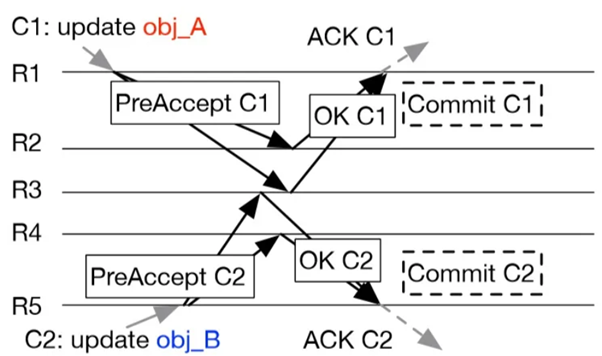
In the pre-acceptance
phase, EPaxos attempts to reach an agreement on the relative order between the
log and other logs and maintain the conflict relationship between the log and
other logs. If no conflicts are found between the log and other concurrently
proposed logs after the pre-acceptance phase ends, the relative order of the
logs is agreed on, and EPaxos can directly send an asynchronous commit message
for submission. If conflicts are found between the log and other concurrent
proposed logs, the relative order of the logs is not agreed on. As a result,
EPaxos must go through the log acceptance phase to reach a majority of the
conflicting dependencies and then sends a commit message to commit.
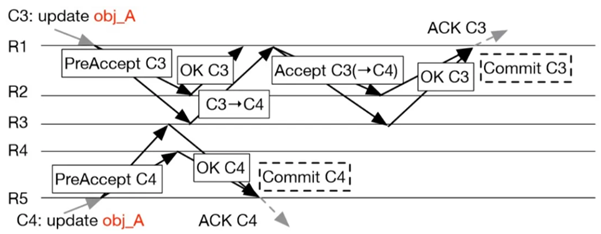
The fast path quorum of
EPaxos is 2F and can be optimized to F+[(F+1)/2]. It is consistent with that of
Paxos and Raft with three and five replicas. The slow path relates to the Paxos
acceptance phase, and the quorum value is fixed to F+1.
EPaxos also has an
active learning algorithm, which can be used to catch up with logs during
recovery. This article does not introduce the algorithm in detail. If you are
interested, read the relevant thesis.
Comparative Analysis
From Paxos to Raft and
then to EPaxos, a comparison among the algorithms can be conducted to present
the evolution. The following section mainly compares and analyzes the
algorithms in terms of understandability, efficiency, availability, and
applicable scenarios.
1. Understandability
As we all know, Paxos
is notoriously ambiguous. It is not only difficult to understand, but also
difficult to implement. On the other hand, Raft, however, aims at improved
understandability and easy implementation. It greatly reduces the threshold of
using distributed consensus and makes distributed consensus more popular. After
Raft was proposed, it quickly gained popularity and greatly promoted the
engineering application of distributed consensus.
EPaxos was put forward
even earlier than Raft, but attained little attention for a long time. One of
the reasons is that EPaxos is difficult to understand. EPaxos is based on
Paxos, but is more difficult to understand than Paxos, which greatly hinders
the engineering application of EPaxos. However, gold always glows. Due to its
unique advantages, EPaxos has gained popularity and is quite prospective.
2. Efficiency
Has any efficiency
improvement been achieved from Paxos to Raft and then to EPaxos? The following
sections compare Multi-Paxos, Raft, and EPaxos in terms of load balancing
performance, message complexity, pipelining, and concurrent processing.
Load
Balancing
The load of Multi-Paxos
and Raft leaders is higher than that of EPaxos, and the load among the replicas
is unbalanced, so the leader is easy to become a bottleneck. However, EPaxos
does not require a leader, and the load among replicas is fully balanced.
Message
Complexity
After a leader is
elected by Multi-Paxos and Raft, only one network round trip is required to
submit a log in most cases. However, Multi-Paxos introduces additional
asynchronous commit message submission. Raft only needs to push forward the
local commit index without using additional messages. EPaxos requires one or
two network round trips based on the log conflict. Therefore, Raft has the
lowest message complexity, followed by Paxos. EPaxos has the highest.
Pipeline
We divide pipelines
into sequential pipelines and disordered pipelines. Multi-Paxos and EPaxos
support disordered pipelines, whereas Raft only supports sequential pipelines due
to the log continuity assumption. However, Raft can also realize disordered
pipelines. It only needs to maintain a TCP-like sliding window for each
follower on the leader and a receiving window corresponding to each follower.
The log of the receiving window is allowed to be discontinuous, and there are
continuous logs outside the window. Once the log is continuous, the window
slides forward, and the pipeline in the window can be disordered.
Concurrent
Processing
Multi-Paxos adopts the
Paxos policy. Once a concurrency conflict is detected, the system rolls back
and retries until it succeeds. Raft uses the strong leader to avoid concurrency
conflicts, so the follower does not compete with the leader, avoiding
concurrent conflicts. EPaxos directly handles concurrency conflicts and treats
conflicting dependencies as a consistency problem to resolve concurrency
conflicts. In short, Paxos adopts conflict fallback, Raft adopts conflict
avoidance, and EPaxos adopts conflict resolution. Logs for Paxos and Raft are
linear. Logs for EPaxos are graph-like. Therefore, EPaxos features better
parallelism and higher throughput.
3. Availability
Any replica in EPaxos
can provide services. When a replica becomes unavailable, the service can be
immediately switched to another replica, with a minor impact on availability.
However, Multi-Paxos and Raft depend on the leader. If the leader becomes
unavailable, leader reelection is required. As a result, the service is
unavailable until a new leader is elected. Obviously, EPaxos has better
availability than Multi-Paxos and Raft. Between Multi-Paxos and Raft, which has
better availability than the other?
Raft adopts the strong
leader. The follower must wait for the lease of the old leader to expire before
launching an election. Multi-Paxos adopts the weak leader. The follower can run
for the leader at any time. Although Multi-Paxos might compromise the
efficiency, it can restore services quicker when the leader fails. Therefore,
Multi-Paxos has better availability than Raft.
4. Application Scenarios
EPaxos is more
applicable to cross-AZ and cross-region scenarios. In scenarios with demanding
usability requirements, the leader is prone to creating a bottleneck.
Multi-Paxos and Raft have similar application scenarios, such as the internal
network. For general high-availability scenarios, the leader is less prone to
creating a bottleneck.