About Ethereum
Understand
Ø What is Ethereum?
Ø Why do you need Ethereum?
Ø History of Ethereum
Ø What is Smart Contract?
Ø Smart Contract vs Traditional Contracts
Ø Ethereum Key Terms
Ø Ethereum vs. Bitcoin
Ø Advantages of Ethereum
Ø Disadvantages of Ethereum
What is Ethereum?
·
Ethereum is an open-source operating system that offers
smart contract functionality.
·
It
is a distributed computing
platform that supports developing decentralized Digital Applications (DApps) using blockchain technology.
·
Ethereum
provides a decentralized
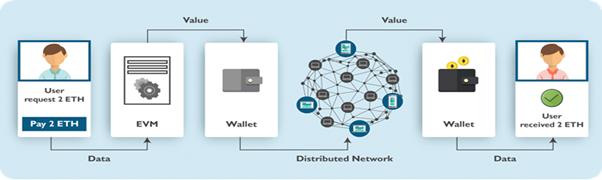
virtual machine called Ethereum Virtual Machine (EVM) that can run
scripts using an international network of public nodes.
·
Ethereum
is the biggest decentralized
software app.
·
It
helps you to build smart
contracts and decentralized applications without any downtime or any
third-party interference.
·
Ethereum
allows the developer to create and publish next-generation distributed applications.
Why do you need
Ethereum?
·
Centralized systems are one of the most widespread models for
software applications.
·
This system directly controls the operation of the individual
units and the flow of information from a single center.
·
In this kind of system, individuals are depended on the central
power to send & receive information.
However,
there are issues with the
centralized system are:
- Single point of control & failure
- It can be corrupt easily
- Performance bottleneck
The Solution is
Decentralized Applications
Ø
Decentralized applications never reply on a centralized backend,
but they interact directly with a blockchain.
Ø
The term DApp is a combination of two
words- decentralized applications. In simple words, it is an application,
tools, or programs that work on the decentralized Ethereum Blockchain.
History
of Ethereum
- 2013: Vitalik Buterin, a developer
who was involved in Bitcoins, and he was first to describe on paper
- 2014: A
Swiss firm Ethereum Switzerland Gmbh developed
the first Ethereum software project
- 2015:
Frontier, the first version of Ethereum was launched.
- On March 14, 2016: A
planned protocol Homestead becomes second biggest version upgrade of the ethereum network.
- On May 2016: Ethereum
gets the most extensive media coverage when the DAO raised a record $150
million in crowd sale.
- On July 2016: The network branched into two broad categories:
Ethereum (ETH) and Ethereum Classic (ETC).
- June 2017: Ethereum rallies above $400 recording a 5001% rise since Jan 1st,
2017
- May
2017- Ethereum will eventually overtake the success of Bitcoins
- June 2018- The DAO was hacked by an anonymous group claiming $50 worth of
ETH.
What is Smart Contract?
 A Smart
Contract is a computer program that executes
automatically.
A Smart
Contract is a computer program that executes
automatically.
It is a transaction protocol that allows blockchain users
to exchange money and property.
It also helps users to perform actions like voting
without any central authority.
It is a virtual third-party software agent that can
automatically execute and enforce terms and actions according to the legal
agreement.
Smart Contract vs Traditional
Contracts
·
Smart contracts are a self-executing computer program,
while traditional contracts are bound by the legal terms.
·
Smart contracts cannot be modified or changed
according to people’s will, while traditional contracts are flexible and can be modified at any time
with the consent of both the parties.
·
Smart Contracts work on the distributed ledger technology,
while Traditional contracts work on the institutional factors and requirements of the two
parties involved.
·
Smart contracts cannot be manipulated or tampered
with, while traditional contracts can be manipulated and changed easily.
·
Smart contracts limit human interaction and
interference while traditional contracts need human intervention.
Ethereum Key Terms
·
Currency
Issuance: It
is mostly managed and monitored by a country's central bank. It is also
referred to as a monetary authority.
·
Decentralized
Autonomous: Decentralized Autonomous Organization is a digital
organization which aims to operate without the need for hierarchical
management.
·
Organizations
(DAO): DAO
is a combination of computer code, a blockchain, smart contracts, and people.
·
Smart
Contracts: It
is digitally signed agreement between two or more parties which relies on a consensus system
·
Smart
Property: The
Ethereum Wallet is a gateway to decentralized applications on the Ethereum
blockchain. It helps you to hold and secure ether and other crypto-assets
which are built on Ethereum.
·
Solidity: Solidity is the smart contract language used in
Ethereum. It is general purpose programming language developed to run in the
EVM environment. Solidity helps you to perform arbitrary calculations. However,
it aims to send & receive digital token and store states.
·
Transactions: A transaction is a message which is sent from one
account to another account that might be the same or empty. It can include
binary data which is called Ether.
·
Ethereum
Virtual Machine: The Ethereum Virtual Machine which
is also known as EVM is the runtime environment for smart contracts. EVM is a
computer layer straight above the underlying hardware. It is not just sandboxed
but isolated. Moreover, the code running inside the EVM doesn't
have any access to network, filesystem or any other processes.
Ether
ü
Ether is a
value token of the Ethereum blockchain.
ü
It is listed as "ETH" on cryptocurrency exchanges.
ü
It helps you to pay transaction fees and computational services on the Ethereum
network.
ü
In the Ethereum network whenever the contract is executed, Ether
is paid.
Gas
§
To perform a transaction
on the Ethereum network, a user requires to make a payment (to
the miner) Ether via an intermediary token called 'Gas.'
§
It is a unit
which allows you to measure the computational work required for running a smart
contract or other transactions.
§ In Ethereum, the transactions fee is calculated
in Ether, which is given as:
o Ether
= Tx Fees= Gas Limit * Gas Price
Where,
- Gas Limit= Refers to the amount of gas that is
used for the computation
- Gas Price= The amount of Ether a user is
required to pay
Ethereum vs.
Bitcoin
|
Parameter |
Bitcoin |
Ethereum |
|
Definition |
Bitcoin is a digital money |
Ethereum is a world computer. |
|
Founder |
Satoshi Nakamoto |
Vitalik Butarrn |
|
Hashing algorithms |
Bitcoin used SHA-256 algorithm. |
Ethereum uses Etash
algorithm. |
|
Average Block time |
10 minutes |
10-15 sec |
|
Release Date |
9 Jan 2008 |
30 July 2015 |
|
Release Method |
Genesis Block Mind |
Prasala |
|
Blockchain |
Proof of work |
Proof of work (Planning for POS) |
|
Usage |
Digital Currency |
Smart Contracts Digital Currency |
|
Cryptocurrency Used |
Bitcoin(Satoshi) |
Ether |
|
Blocks Time |
10 Minutes |
12-14 Seconds |
|
Mining |
ASIC miners |
GPUs |
|
Scalable |
Not now |
Yes |
|
Concept |
Digital money |
World Computer |
|
Cryptocurrency Token |
BTC |
Ether |
|
Turing |
Turing incomplete |
Turing complete |
|
Coin Release Method |
Early mining |
Through ICO |
|
Protocol |
Bitcoin still employs the pool
mining concept. |
It uses a Ghost Protocol. |
Applications Ethereum
- Banking: With Ethereum's decentralized system. It is almost impossible for
a hacker to have unauthorized access to an individual's personal
information.
- Agreements: By using a smart contract, agreements can be
maintained and executed without any alteration.
- Prediction market: The prediction market is another wonderful
use case of Ethereum Smart Contract. The platforms like Gnosis and Augur
use Ethereum for this purpose.
- Digital Identity Management: Digital identities can be managed by using
smart contracts which solve the major issues of identity theft and data
monopoly.
Advantages of Ethereum
- Allows
to upload and request programs to be executed:
- 100%
uptime and DDOS resistant.
- Ethereum
helps to create a tradable token that you can use as a new currency or
virtual share.
- Persistent
and permanent data storage
- Build
virtual organizations
- Helps
you to develop decentralized applications
- Ethereum
helps you to build fault-tolerant and highly secure decentralized apps.
Disadvantages of Ethereum
- The
Ethereum Virtual Machine is slow, so you can't
use it for large computations.
- Storage
on the blockchain is expensive.
- Swarm
Scalability is an issue, so there is a trade-off with decentralization
Private block chains are likely to proliferate.
- Fixing
bugs or updating Apps is a tough task because every peer in the network
need to update their node software.
- Some applications require verification of user identity, and as
there is no central authority to verify the user identity.